
Introduction
Seattle has long had two disconnected streetcars that have received tough love over the years. And rightfully so. The streetcars suck. Our streetcars are so bad that city councilmember Bob Kettle is pushing to get rid of the entire SLU streetcar — the very streetcar that runs through his own district. And there isn’t serious pushback, even within transit advocacy circles. However, this is terribly misguided. The SLU streetcar has real problems, but we shouldn’t abandon the system; we need to fix it. When done right, streetcars are the best form of surface transit — bar none.
It’s hard to imagine anyone advocating for building a robust streetcar network, especially when ours is so non-functional. That’s because most people in Seattle have never experienced a great modern streetcar (or as Europeans say, tram) network. There are precisely zero cities in North America that have done streetcars right. This makes it difficult for Seattleites to really understand what a modern European-grade tram network really feels like. When done right, trams are remarkably fast, comfortable, quiet, reliable, and very cost effective. And they are the single greatest catalyst for enabling good urbanism and walkability.
Why our streetcars suck
If streetcars are so great, what makes our SLU streetcar (affectionately known as SLUT for SLU Tram) so bad that the city wants to shut it down? There are five main reasons.
- Excruciatingly slow
- Extremely unreliable with embarrassing on-time performance and low frequency
- Poor urban integration
- Too expensive to operate
- Not enough ridership
Many in Seattle believe these issues are unique to streetcars and they should be replaced by more flexible and cheaper-to-operate busses instead. But this is extremely misguided, and points to a fundamental misunderstanding of how we use streetcars in North America. We understand that commuter rail and metro serve distinct purposes, yet we fail to understand that busses and streetcars also serve fundamentally different purposes and that we should not design both systems the same way. The five issues mentioned above are emblematic of designing and operating streetcar service as a replacement to bus service. And this makes the streetcar even more vulnerable to its removal because it can “simply be replaced by a cheaper bus.”
If we design our streetcars and treat them like a modern European tram network rather than a local bus line, all those issues would be fixed and the network would drive significantly more ridership than even our highest ridership bus lines, and at a lower cost than any bus — while having a ton of knock-on benefits to the city that no bus can offer. It’s been proven in countless other cities, and WSDOT themselves studied the Culture Connector and estimated it would drive 28,000 riders per day on the connected streetcar line. This would make it busier than Seattle’s busiest bus line, the RapidRide E Line, attracting about 14,000 riders per day today. Put another way, Seattle’s busiest bus line would drive only HALF of the ridership of the connected streetcar line, yet folks are advocating for the removal of our streetcar.
How do we fix it?
The primary reason Seattle wants to shut down the streetcar is because it is “too expensive to operate per rider.” So, let’s start with fixing this.
The primary reason the SLU streetcar is so expensive is because building and operating rail is much more expensive than busses, but only if the line can’t drive enough ridership. When a streetcar can drive significant ridership, cost per rider is less than running bus service. The SLU streetcar only attracts about 500 trips per day and costs the city over $20 per rider on average due to the low ridership. So, the streetcar desperately needs to attract more riders for the per rider cost to go down.
Riders depend on reliable transit that is reliable, fast, and comfortable. Since there is a lot of fixing to do, let’s break it down into three phases.
Phase 1
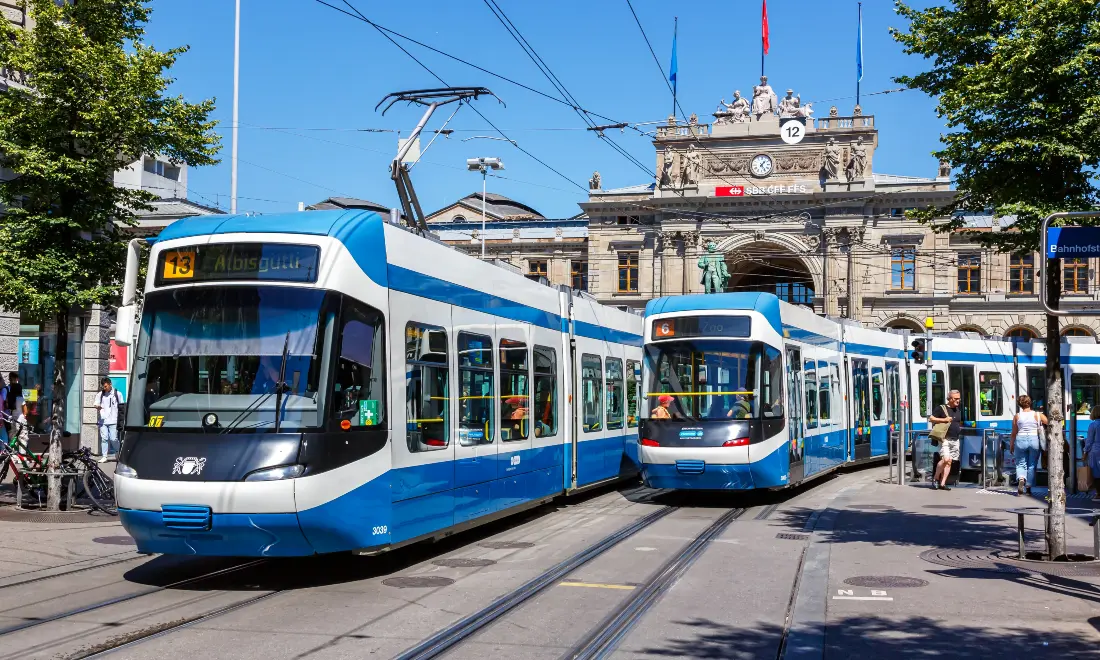
To make the streetcar more reliable for transit riders, it must improve its on-time performance. In Zürich, their trams arrive exactly on the scheduled minute more than 90% of the time across 700+ stops and 19 lines making it ultra-reliable for riders. For us, the tiny SLU streetcar line can barely hit 60% on-time through rush-hour even though we define “on-time” more leniently as 5 minutes before or after the scheduled arrival time. This must be fixed so that transit riders know that the streetcar will arrive exactly on the scheduled minute of arrival.
To do this, the streetcar must have full dedicated right of way and transit signal priority. Lights should turn green for the streetcar before the streetcar arrives at the intersection to let it through. The streetcar should never have to slow down.
This will immediately significantly increase ridership because riders can know that the streetcar will arrive when it is scheduled, and that they will get where they need to quickly and reliably. Plus, if we are investing in very expensive streetcar infrastructure, why shouldn’t we be doing everything we possibly can to make sure that expensive infrastructure is being as well utilized as it possibly can be? We shouldn’t build expensive infrastructure and then waste it by allowing our streetcars to be stuck in traffic, at stoplights, and at stops.
Currently, riders have no idea when the streetcar will arrive because the line is too short for real-time location-based estimates to be accurate and King County Metro (the operators of the line) doesn’t adhere to schedules. Riders may end up waiting 5 minutes or 20 minutes. Once dedicated right of way and transit signal priority are added (both of which are low-cost fixes), King Country Metro must strictly adhere to the schedule and arrive exactly on time at every stop so that riders can depend on the line.
Phase 2
The SLU streetcar is only 1.3 miles long. If a trip is only 1 mile long and the streetcar is chronically slow and unreliable, a rider will obviously choose to walk, scooter, or bike that distance instead. Europe understands that a streetcar/tram cannot be this short. The SLU streetcar would be the shortest streetcar line on the entire continent of Europe (a continent with hundreds of streetcar lines). In fact, it’s actually insane that the streetcar is only 1.3 miles long and it makes no sense whatsoever for any functioning transit service that is not simply a tourist line.
We must expand the length of the streetcar to serve more destinations and connect riders to more places, quickly and efficiently (with dedicated right of way and transit signal priority). This is why the Cultural Connector is such a critical project that must be revived immediately. It is a 1.27 mile extension, but it would connect the First Hill and SLU streetcars and create a continuous line, connecting riders across the city, creating a network effect and significantly increasing the utilization of the expensive streetcar infrastructure. As mentioned before, the combined line going through 1st Ave is estimated by SDOT to generate 28,000 riders per day — an absolute monstrous gain over the 500 riders per day on the SLU line. This combined line would be great for the city, and would also make the streetcar significantly cheaper to operate than an average King County bus line because the line would be serving a very high number of riders, completely eliminating the “high cost per rider” concern. No one complains about the high cost per rider on the Link light rail, because it’s much cheaper to operate per rider than a bus. The combined streetcar line is estimated to generate 25% of the ridership of the entire Link light rail system today, simply by adding 1.27 miles of additional track, on a system that is much cheaper to operate and build than even the Link light rail. It is hands-down the best financial decision for the city, and it’s insane that we are not all-in on building the Culture Connector.
Phase 3
The streetcar needs to be expanded out from the Cultural Connector line. It should go farther up 1st Ave, be extended up through Capital Hill, and have a branch that goes up Madison, replacing the G line. We should also have a streetcar run down our new waterfront, replacing the waterfront shuttle, and removing noisy and dangerous car traffic and completing the vision of the waterfront being a true park. Additionally, a streetcar should run from Boren down Rainier, replacing most of bus line 7 (currently pending to become a RapidRide line) going through dense housing and retail areas. And finally, another streetcar ought to run down Denny Way replacing bus line 8, bringing reliability and punctuality to riders on Denny. These lines are all interconnected, already have tremendous ridership, and connect critical neighborhoods together easily. The network effect of trams would drive much higher ridership per line than their respective bus lines if we build them right.
What tenants should our tram system follow?
- The entire tram network must have its own right-of-way.
- Trams must be able to move through every intersection without stopping by utilizing Transit Signal Priority. It should only stop at an intersection to allow another tram to pass through the intersection if it arrived at the intersection first.
- Trams must connect to destinations directly without weird loops or detours, and with superb urban integration.
- Trams must be cost-effective to build and operate.
- Trams must be perfectly punctual, with 90%+ on-time performance across the network, being no more than one minute early, or two minutes late.
Conclusion
If we follow these tenants and build our tram system accordingly, the tram network would easily drive 100,000+ riders per day across the system, more than what Link light rail drives, and at a small fraction of the cost. If we do it right, it would serve more riders and at a cheaper cost than equivalent bus service today, where riders get a much better experience as well.
Other cities have robust tram networks driving tremendous ridership at a low cost. We can do it too. If Seattle is serious about our goals as a state and about reducing Vehicle Miles Travelled, we must do this.
| Seattle | Zürich | |
| City population | 731,000 | 443,000 |
| Tram lines | 2 | 18 |
| Total tram track length | 3.8 miles | 107 miles |
| Total ridership (2024) | 1,380,000 | 205,000,000 |
| Average cost per mile | approx. $300-$400 million | approx. $100 million |