
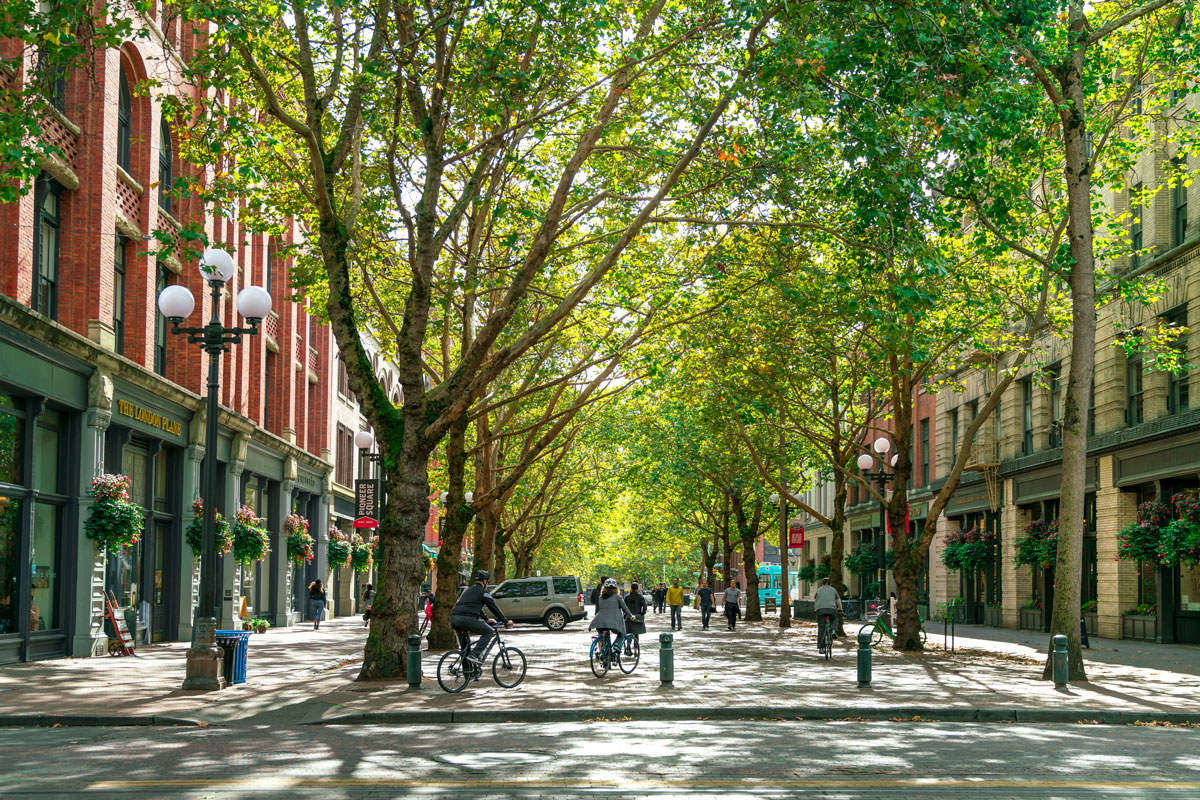
Seattle is a city blessed with an abundance of natural beauty. It’s also a city that is rapidly growing in population, bringing in talent from across the world, but is unequipped to handle it as evidenced by the intensity of the housing crisis. As the city has pushed to adopt the One Seattle Plan, a roadmap guiding the city’s growth and investment over the next 20 years, there has been strong support for increasing housing supply and also strong support for protecting our trees and nature. Strangely, these two issues have been pitted against each other, protecting trees versus building more housing. It does not need to be this way. We can have both at once. And other cities across the world have been remarkably successful at achieving this.
From our old development patterns, Seattle has already largely lost an astounding number of trees over the last 150 years — mostly occurring since our city was redeveloped and bulldozed for the car. Now, most of the city is oriented around incredibly space-inefficient car infrastructure which required clear-cutting large portions of the city to allow for low-density single family housing. Seattle has transformed, like the rest of the USA and Canada, into a large sprawled area where the land and nature has been destroyed in favor of low-density car-dependent infrastructure where basic amenities to live your life are too far to access by walking. Most people in the city will drive everywhere just to live their life. Since everything is too far apart and public transportation is too slow, they’ll hop in the car to buy bread from the grocery store, to go to the doctor, to get to work, and yes, to even go to the gym. Humans have existed for thousands of years in walkable cities before the car was invented, and yet, most people now are so isolated and so stationary that we need to purposely go to the gym to get some basic movement, and we can’t even walk to get there because it’s too far away without a car.
When over 70% of the entire city’s land is dedicated to single-family housing sprawl while everything else — office space, industrial land, multifamily housing, parks and green spaces — gets less than 30% shared between them, it’s a problem. It is deeply inequitable, terrible for the environment, and ultimately, it is wrong.
It is possible to make our city walkable, affordable for all, all while preserving and significantly growing our green spaces and tree coverage. And the answer is quite simple. We must densify, get rid of our car infrastructure, connect our city’s neighborhoods with modern trams and light rail, and regrow the trees and green spaces we have lost previously in the land we get back. More housing and strong public transportation means lower housing prices, and it also means more people can get to their jobs and daily necessities without needing to pay for a car and all the associated costs. For families, it means they can downsize from two or three cars to one.
| Seattle | Paris | |
| Total Land Area | 83 mi2 | 41 mi2 |
| Total Population | 780,000 | 2,100,000 |
| Total Green Space | 6,500 acres | 7,300 acres |
| Total Housing Units | 368,000 | 1,350,000 |
Paris has 3x the housing units, and nearly 3x the population — all on less than half the land area. And it still somehow manages to have more green space than we have for their residents to enjoy.
Paris is able to make much better use of this land precisely because there is such a strong emphasis on non single-family housing paired with fast, reliable, frequent, dependable public transportation. And they’re doubling down on this. In fact, their current mayor has spent the last decade aggressively pushing to make Paris effectively car-free and has already had tremendous success in doing so.
Our incessant need to prioritize car infrastructure has completely destroyed our ability to use our land effectively and equitably, while simultaneously destroying our green spaces. And for that reason, anyone who is against densification in their neighborhood to “protect the trees” (as seen in countless recent city council meetings) are either wildly ignorant or are intentionally using trees as a scapegoat to protect their wealth and drive further inequity.
Trees and densification is not a zero sum game. We can increase both at the same time.
In a future blog post, we will discover how cities around the world have designed transportation systems that support walkability, green spaces, and affordability. Seattle has an opportunity to radically transform itself into a more equitable city, that is greener, cleaner, safer, and more beautiful.