
Last month, we explored Sound Transit’s Ballard to West Seattle light rail project, (the single most expensive light rail project in human history), coming out at a cost many times higher than much better, fully automated, driverless, grade-separated metro systems in Europe and Asia. This project is expected to drive by far the most ridership to the system of any other project in ST3 and therefore makes it the most critical and needed line in the system. However, the explosion in the cost, upwards of $20,000,000,000, has now put the entire Sound Transit 3 package at risk of not being complete.
Currently, the plan is to send the light rail underground through downtown. Strangely, the plan is to also have the trains run underground through West Seattle as well due to concerns from residents about how the elevated line would look. However, underground construction is extremely expensive: 2-3x the cost versus building an elevated line, and 3-8x versus building at-grade. The underground portions of the this line are a large contributing factor for astronomical costs. There are cases where building underground is necessary and justifies this cost, namely in large and dense cities that move millions of people per day. However, in mid-sized cities like Seattle, tunneling so much is not necessary, especially for a line that is designed to connect different neighborhoods within the city where people will be taking short trips. People taking short trips matters to the design of the system (i.e. going from Ballard to SLU or from Westlake to West Seattle) because getting to and from the train platform takes a significant portion of the travel time. If it takes 3 minutes to get between the platforms and the surface level (typical for Seattle’s downtown stations), you’ve automatically added at least 6 minutes to the trip time. If the train trip is only 7 minutes long (i.e. Westlake to UW or Ballard to SLU), getting to/from the platform nearly doubles the total trip time because these stations are so deep. Since the Ballard/West Seattle line will be entirely within Seattle city limits and will mostly have riders going only a few stops rather than cross an entire region, the platform to/from surface time matters a lot.
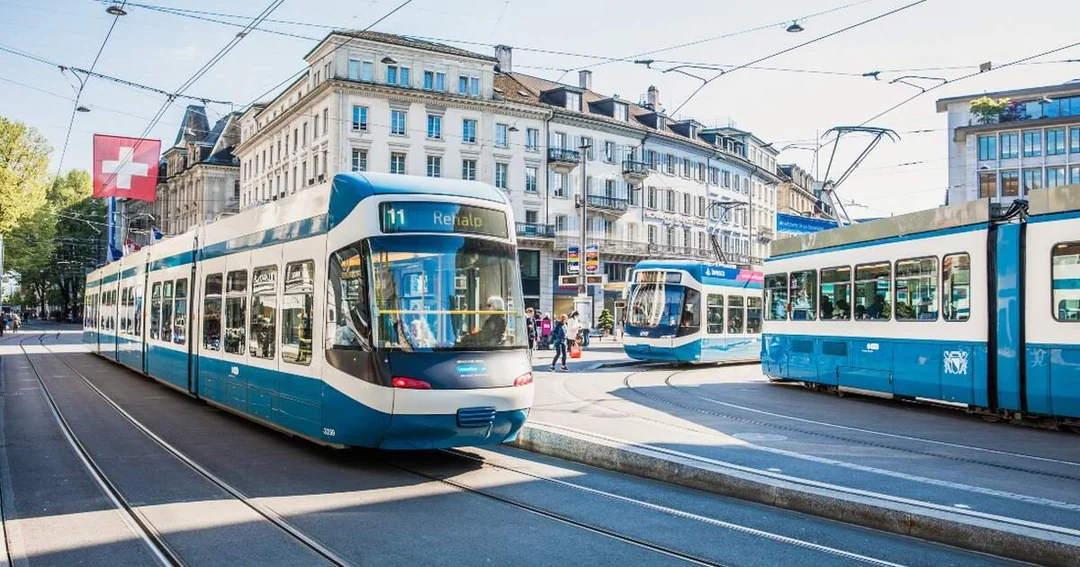
Well designed tram systems in Europe run trams at the surface at similar average speeds as Seattle’s tunneled Link through downtown, which means their total trip time is actually significantly faster because they don’t have any platform to/from surface time added on. And because building at-grade is 3-8x cheaper than tunneling, they’re able to build 3-8x the number of miles and stations for the same amount of money, giving them far greater high-quality transit coverage across the densest parts of their cities.
The screenshots below show the differences at the same scale of transit coverage between Seattle and Zürich. In Seattle, only the green line, bright orange line, and blue lines are rail (each is a separate service handled by a different agenciy), whereas in the Zürich picture, every line shown is high quality, fast, frequent rail service.


Proper planning at the surface allows for trams to run as quickly and efficiently as below the surface. This is shown in Zürich, where their average tram speed through the densest parts of the city on Line 4 is ~10 mph at surface, while Link’s average speed through our expensive downtown rail tunnel is ~9 mph. Zürich achieves these speeds through aggressive signal priority (trams never stop at lights unless another tram arrived at it first!), fully dedicated right of way on the street, center running trams to avoid conflicts with other vehicles, tram-only streets, and high quality rail junctions.


Because the second downtown tunnel’s cost in Seattle is far more expensive than initially expected, Claudia Balducci, a member of the King County Council, is currently advocating for increasing capacity through the existing tunnel through upgraded signaling and other infrastructure improvements to allow interlining lines 1, 2, and 3 through the same tunnel. Even if the city is able to make this work, it will introduce a massive single point of failure. If something goes wrong in the downtown tunnels (as it often does), the entire Link system breaks across lines 1, 2, and 3. This effectively cripples the entire regional system. And since that tunnel would see significantly more usage with interlining between three high-frequency lines, there’s a much higher chance that things could go wrong and that frequencies would have to be severely limited across the system during maintenance periods.
If we build Line 3 (Ballard to West Seattle) through downtown, but at-grade, held at the same standard as the best tram systems in Europe, we solve all of our problems:
- We introduce a significantly more reliable and redundant system.
- We make trips through downtown just as fast, and significantly faster for shorter trips due to no added platform from/to surface time.
- We achieve both these benefits at 5-8x lower cost.
Many folks in Seattle insist on Seattle never building rail at-grade because they associate at-grade rail with delays and safety issues due to poor design choices along MLK Way. However, those same folks don’t complain about the at-grade segment between Stadium and SODO stations because this segment is safe, fast, and reliable. All at-grade rail is not the same. At-grade can be done wrong, and it can be done well. And when done well, the results are astoundingly cost effective, fast, and convenient to use. NJB recently posted a fantastic video that explains how the tram/streetcar experience can differ vastly purely based on design choices.
This is a no-brainer and we ought to consider the viability of building our West Seattle to Ballard line at-grade through downtown.